A B2B SaaS platform that helps companies transform their scattered team knowledge into a fully searchable, AI-summarized, and transcribed video repository.
Search everything your team has recorded…
3 matches in “Chronicle – Stunning Stories. Made effortlessly”
Transcript · 00:45“…turning it into a polished, pitch-ready narrative.”
AI Summary“…transform raw ideas into interactive, visually compelling story decks.”
Description“…how Chronicle turns raw ideas into pitch-ready narratives.”
Contact Us
John SmithAdministration
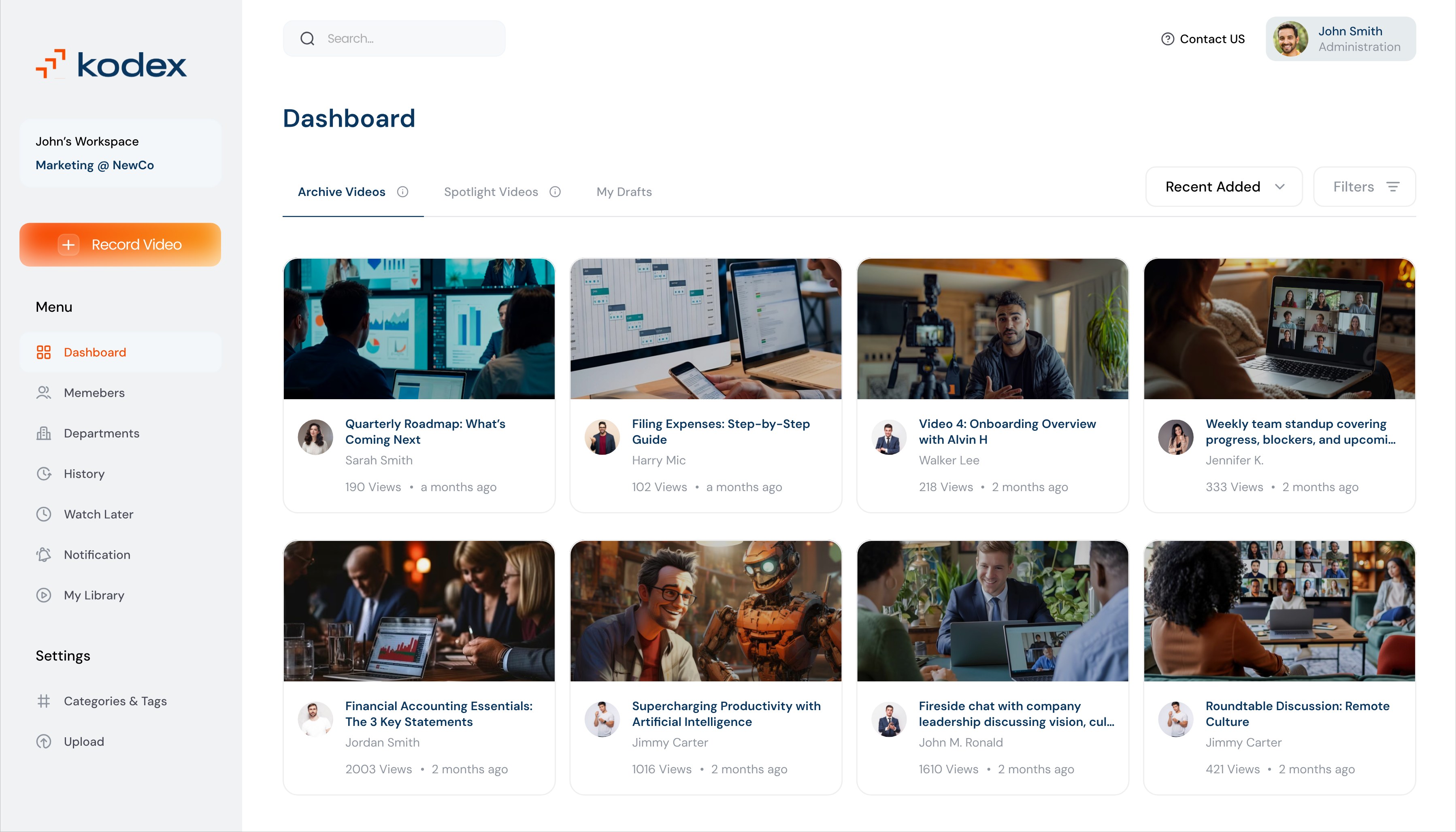
Dashboard
Archive VideosSpotlight VideosMy Drafts
Quarterly Roadmap: What’s Coming NextSarah Smith190 Views · a month ago
Filing Expenses: Step-by-Step GuideHarry Mic102 Views · a month ago
Video 4: Onboarding Overview with Alvin HWalker Lee218 Views · 2 months ago
Weekly team standup: progress and blockersJennifer K.333 Views · 2 months ago
Financial Accounting EssentialsJordan Smith2003 Views · 2 months ago
Supercharging Productivity with AIJimmy Carter1016 Views · 2 months ago
Fireside chat with company leadershipJohn M. Ronald1610 Views · 2 months ago
Roundtable Discussion: Remote CultureJimmy Carter421 Views · 2 months ago
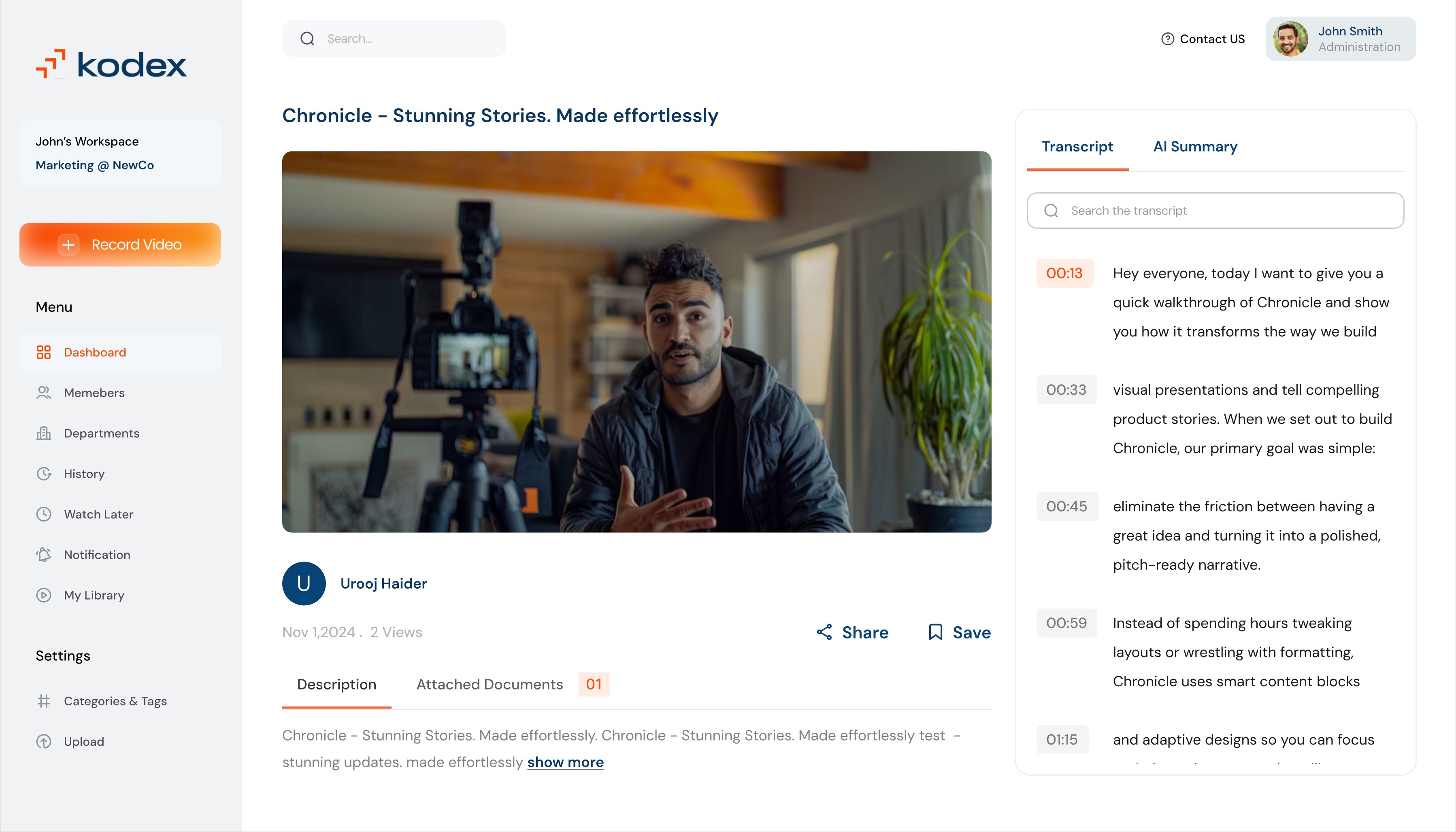
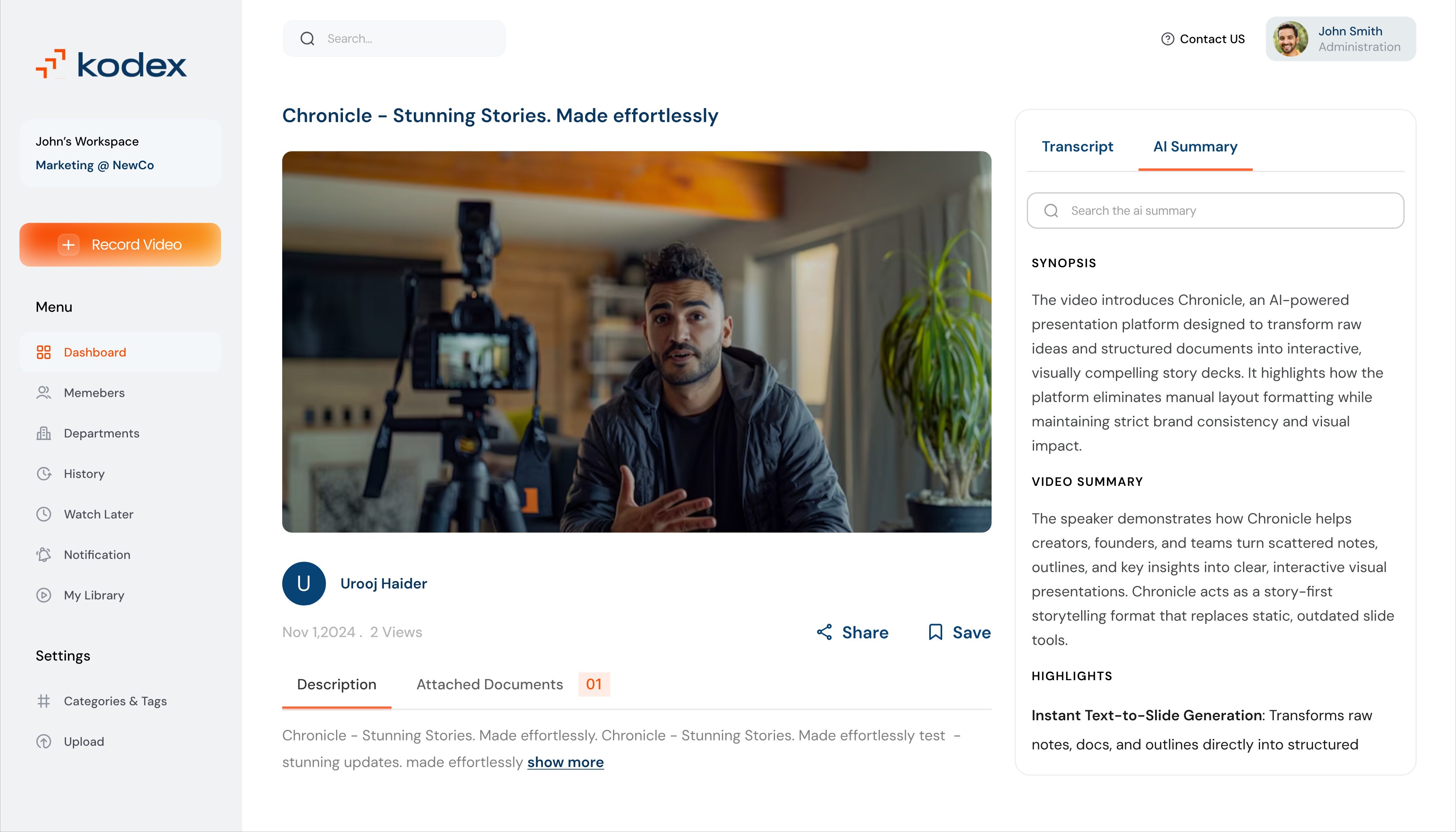
Chronicle – Stunning Stories. Made effortlessly
UUrooj HaiderJust now · 0 Views
#Productivity#Artificial Intelligence
DescriptionAttached Documents 01
Chronicle – Stunning Stories. Made effortlessly. A quick walkthrough of how Chronicle turns raw ideas into pitch-ready narratives.
TranscriptAI Summary
Search the transcript
Transcribing…
Hey everyone, today I want to give you a quick walkthrough of Chronicle and show you how it transforms the way we build
visual presentations and tell compelling product stories. When we set out to build Chronicle, our primary goal was simple:
eliminate the friction between having a great idea and turning it into a polished, pitch-ready narrative.
Instead of spending hours tweaking layouts or wrestling with formatting, Chronicle uses smart content blocks
and adaptive designs so you can focus on the story.
SYNOPSIS
The video introduces Chronicle, an AI-powered presentation platform designed to transform raw ideas and structured documents into interactive, visually compelling story decks.
VIDEO SUMMARY
The speaker demonstrates how Chronicle helps creators, founders, and teams turn scattered notes, outlines, and key insights into clear, interactive visual presentations.
HIGHLIGHTS
Instant Text-to-Slide Generation: Transforms raw notes, docs, and outlines directly into structured slides.
Members (4)
Onboard all your team members here.
FM
Fareeha MohsinIT departmentEngineeringCreated on: March 1, 2023Member
⋮
SS
Sarah SmithMarketingMarketing @ NewCoCreated on: March 1, 2023Admin
⋮
HM
Harry MicFinanceFinance teamCreated on: March 1, 2023Member
⋮
WL
Walker LeeEngineeringPlatform teamCreated on: March 1, 2023Member
⋮
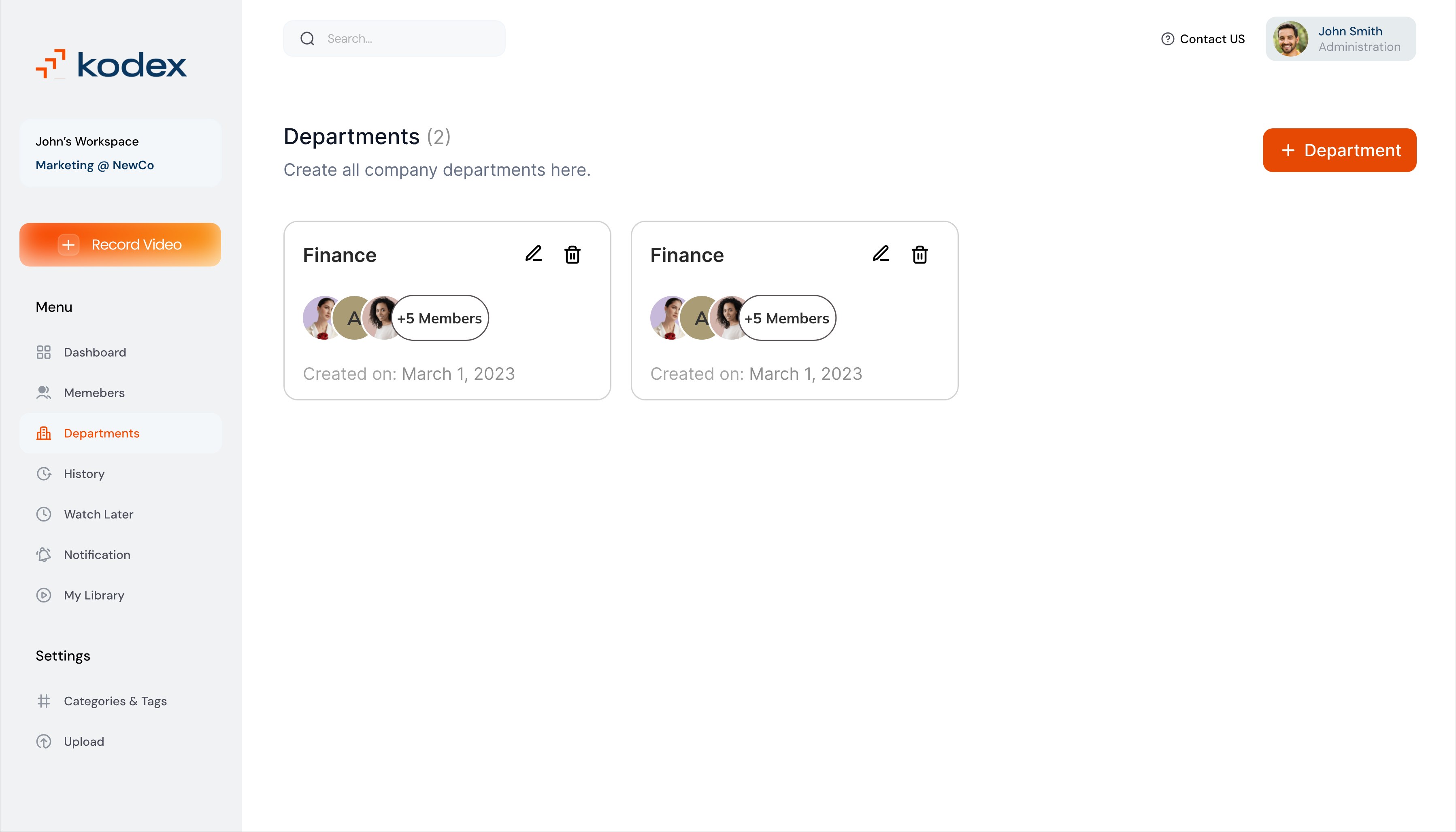
Departments (3)
Create all company departments here.
Finance
+5 Members
Created on: March 1, 2023
Engineering
+8 Members
Created on: March 1, 2023
Marketing
+4 Members
Created on: March 1, 2023
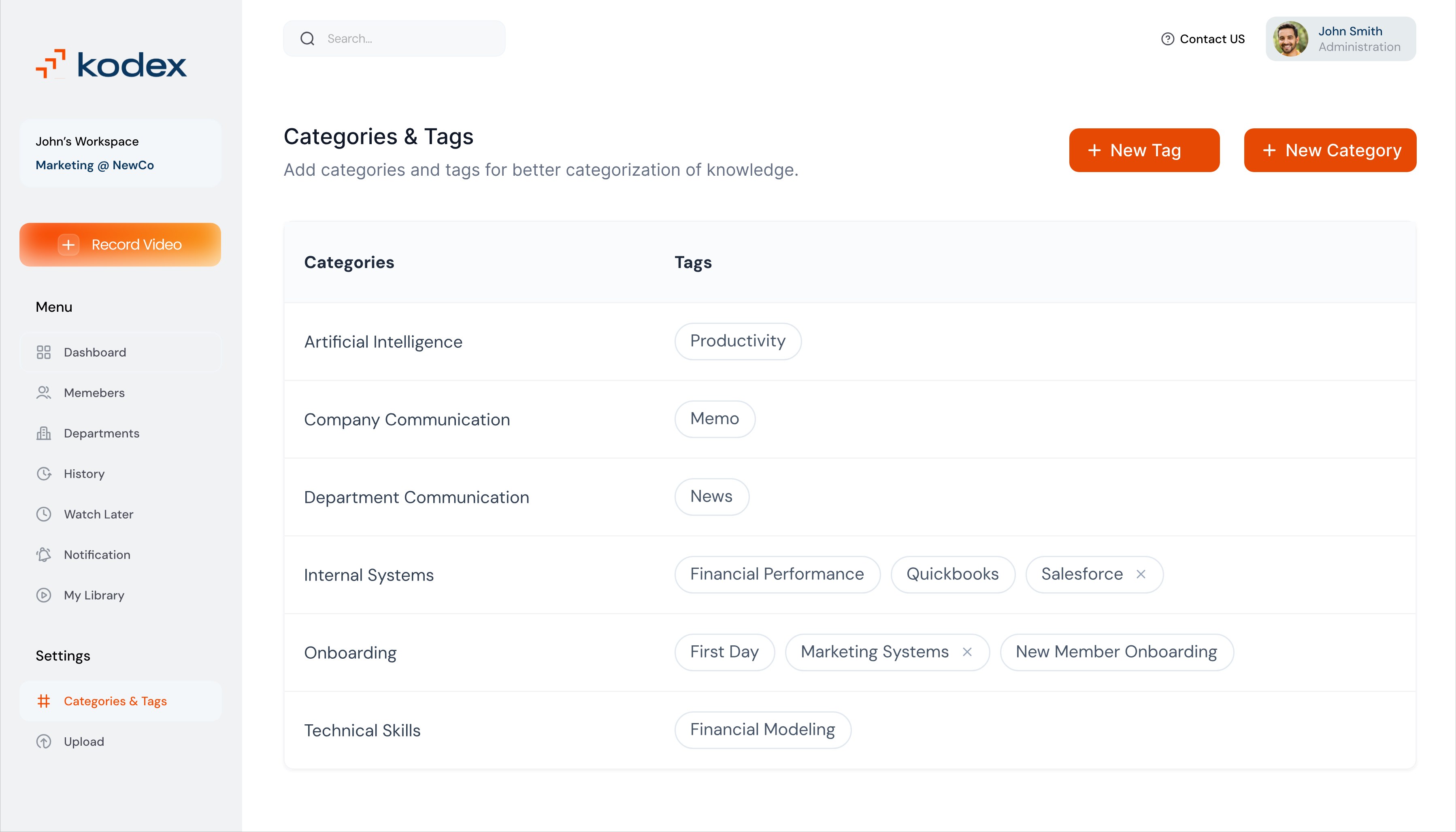
Categories & Tags
Add categories and tags for better categorization of knowledge.
Categories
Tags
Artificial Intelligence
Productivity
Company Communication
Memo
Department Communication
News
Internal Systems
Financial PerformanceQuickbooksSalesforce
Onboarding
First DayMarketing SystemsNew Member Onboarding
Technical Skills
Financial Modeling
History
Videos you watched recently.
Video 4: Onboarding Overview with Alvin HWalker LeeWatched today
As organizations grow, so does the knowledge their teams create. Yet much of that stays confined to a few team members, ends up deep in Slack threads, or in some shared Google Doc.
My approach
To address this, I led the end-to-end design and development of Kodex. Starting with qualitative user research, I worked closely with cross-functional teams to build an enterprise platform that provides institutional knowledge with a permanent, searchable home.
Problem
Knowledge was scattered across people and tools.
Research showed that employees weren’t struggling because information didn’t exist; they struggled because it was scattered.
01Docs too long to skim
02Videos with no transcripts
03Resources split across Slack and email
My role
Lead Developer and Designer
I owned Kodex end to end, from the first user interview to launch, working closely with the client and cross-functional teams.
Research
Ran 10 in-depth interviews, created user personas and a competitive analysis.
Product
Turned research insights into features and prioritized them with the client.
Design
Designed the flows, wireframes and high-fidelity prototype.
Engineering
Led development and launched the product in January 2026.
Research
What the interviews revealed
I talked to 10 professionals across product, engineering, design and operations about how they find information, share context and work together day to day.
Answers are given live in calls and huddles, then they disappear.
Most of the time I just jump on a quick Zoom or Slack huddle and walk someone through it.
Sometimes I’ve explained the same process multiple times, just to different people in different calls.
We’ve shared a lot of knowledge through recordings, but there’s no real system to organize or reuse them.
We use Loom a lot, but those videos just get buried in Slack threads after a while.
Theme 02
Work is often repeated
The same walkthroughs get repeated for every new person.
Sometimes I’ll think, ‘didn’t I already explain this last week?’ but there’s no way to reuse it.
Every time someone new joins, we go through the same walkthroughs again from scratch.
We don’t really have a place to point people to, so we just keep explaining things over and over.
For onboarding, it’s basically the same set of calls repeated for every new person.
Theme 03
Knowledge lives in people
A few people hold the context, so everyone pings them.
On our Gen AI team, only [redacted] really knows how the prompt pipelines are set up. If something breaks, everyone just pings him.
We have documentation, but honestly, it is not up to date. We just ask whoever worked on it last.
A lot of our internal tools were built quickly, so the knowledge never really got written down, it’s just passed along.
Even for simple things, like how to run certain scripts, I still double-check with someone instead of trusting the docs.
Theme 04
Documentation is unreliable
Docs go stale fast, so nobody trusts them.
We have a Notion page for most things, but honestly, I don’t trust it. Half of it is outdated or missing steps.
We created a bunch of docs when we started, but no one really goes back to update them.
Some of our internal tools are documented, but only at a high level. The actual details are just learned through experience.
We’ve had cases where new hires followed the docs exactly and still got stuck because steps were missing.
Synthesis
Not a lack of knowledge. A lack of access.
The four themes weren’t separate problems. Each one fed the next, so the same knowledge kept getting lost and explained again.
Huddle#eng-onboarding14:32
Not recorded
01Knowledge is shared informallyAnswers are given live in calls and huddles, then they disappear.
Deploy pipeline: setup
Last edited 11 months ago
Clone the repo
Install dependencies
Run setup.sh
02Documentation is unreliableDocs go stale fast, so nobody trusts them.
Direct messages
DanaKnows how the pipeline works
12
quick q about the prompt pipeline
how do I run the eval script?
03Knowledge lives in peopleA few people hold the context, so everyone pings them.
Onboarding walkthrough
Mar 3Walkthrough, new hire45 min
Mar 17Walkthrough, new hire45 min
Apr 2Walkthrough, new hire45 min
04Work is often repeatedThe same walkthroughs get repeated for every new person.
Kodex breaks the loop at step 01: record a walkthrough once, and it never has to be repeated.
People
User Personas
Two personas synthesized from the interviews above.
DanaTeam lead, tired of repeating herself
Age
34
Occupation
Engineering team lead
Location
Austin, TX
Team size
12 people
Tech literate
High
“Sometimes I’ll think, didn’t I already explain this last week?”
Personality
OrganizedMentorDirect
Bio
Dana has led a team of 12 for four years. Most weeks, a real chunk of her time goes to re-explaining the same onboarding steps and decisions to whoever asks next.
Core needs
A way to point people to an answer instead of re-explaining it live, every time
A single source of truth for how her team’s past decisions were made
Frustrations
Repeat questions eat into her week
The docs that do exist go stale fast, so nobody trusts them
She’s become “the answer” for things that should just be searchable
Tools used daily
MalikNew hire, missing the tribal knowledge
Age
24
Occupation
Junior ML engineer
Location
San Francisco, CA
Tenure
2 months
Tech literate
High
“If something breaks, everyone just pings Dana.”
Personality
CuriousSelf starterCautious
Bio
Malik joined the Gen AI team two months ago. He’s sharp and self-sufficient, but keeps hitting walls where only one senior teammate actually understands how something works.
Core needs
A searchable record of decisions and processes, not just a person to ask
A way to ramp up without waiting on someone else’s calendar
Frustrations
Undocumented systems where one person holds all the context
Feeling like he’s bothering people with basic questions
No way to tell if an answer he found is still current
Tools used daily
Ideation
Designing a closed-loop knowledge ecosystem
Capturing knowledge and finding it couldn’t be solved separately, so I sketched the whole flow first: from recording a walkthrough to a teammate finding it weeks later.
Dashboard · lo-fi
1
1Every video is recorded and tagged automatically
Video page · lo-fi
1234
1Large video display, front and center
2Transcript and AI summary tabs
3Transcripts generated with the OpenAI Whisper API
4Tags so videos are easy to search
Key decisions
Two calls that shaped Kodex
Decision 01
Video first, not docs
Instead ofLong written documentation
I choseOne-click recording
Most participants preferred recording a video over writing and updating long docs. Making recording the easiest action meant knowledge would actually get captured.
Decision 02
Searchable from day one
Instead ofVideos you have to rewatch
I choseAutomatic transcripts
Video alone would recreate the problem: long recordings nobody can search. Because I was also building Kodex, I chose the OpenAI Whisper API so every recording is transcribed and searchable as soon as it’s uploaded.
Designs
From insights to interface
Every feature maps back to a pain point from the research.
01
Capture knowledge instantly
Most participants preferred recording a video over writing long docs, so in Kodex, recording is the easiest way to share knowledge.
Solves: docs too long to skim
Recording02:14
02
Turn conversations into searchable transcripts
Every recording is transcribed automatically, with timestamps, so any moment can be found by search instead of rewatching.
Solves: videos with no transcripts
03
AI summaries that drive clarity and action
Summaries surface the key decisions and next steps, so teams get the point in seconds.
Solves: rewatching recordings for one detail
✓Summary ready
04
Organize knowledge across teams
Videos are grouped by team and department, so people find what’s relevant and ownership stays clear.
Solves: knowledge stuck with a few people
Finance+5 members
05
Structure knowledge with categories and tags
Instead of getting buried across tools, recordings are tagged and categorized so teams can find them instantly.
01The real problem is often not the one you’re handed.
I expected a documentation problem. The interviews showed knowledge already existed; people just couldn’t get to it. That reframe shaped every feature.
02Lower the effort, and people will share.
People weren’t avoiding sharing knowledge; they were avoiding writing it down. Making recording one click mattered more than any feature on top of it.
03Designing and building together leads to better decisions.
Because I was also the developer, I knew early what was feasible, like transcription with Whisper. That let me design around real constraints instead of assumptions.
04 · Next timeDesign for the habit, not just the feature.
Recording is easy, but making it routine is the hard part. I’d explore capturing knowledge directly inside Slack and Zoom, where teams already work.
“I often present a problem and give her the autonomy to devise a solution, one that is almost always spot on and requires minimal iteration.”
Zein Zoulfikar · Financial Sponsors Group, J.P. Morgan